
What If the Holes in Your Leaves Aren't a Problem?
What if the holes in your leaves are not a sign that your garden is failing, but evidence that something is actually using it?
I started thinking about this differently during a guided tour at the Coastal Maine Botanical Gardens.
As we walked through the gardens and surrounding woods, our guide repeatedly stopped to point out leaves with holes, ragged edges, and other signs of chewing. Instead of describing the damage as something unfortunate, she treated it as a positive sign. The plants were not simply there to look beautiful. Insects were using them for food and habitat.
It had honestly never occurred to me to look at chewed leaves that way.
I thought about the holes I regularly see on the bee balm, hummingbird mint, and black-eyed Susans in my own garden. I had always noticed the damage first. Now I began to wonder whether I had been looking at it all wrong.
Maybe a chewed leaf did not mean the plant needed to be fixed. Maybe it meant the plant was doing exactly what I had hoped it would do.
That idea stayed with me. Then, not long afterward, something in my own garden made it feel much more real.
I noticed webbing and curled leaves on my native pussytoes (Antennaria) in my Massachusetts garden. My immediate reaction was familiar: “Oh no. What’s wrong with this plant?”
Then I remembered the tour in Maine and looked more closely.
Among the curled leaves, I saw small specks of frass, or insect droppings. Something had clearly been using the plant.
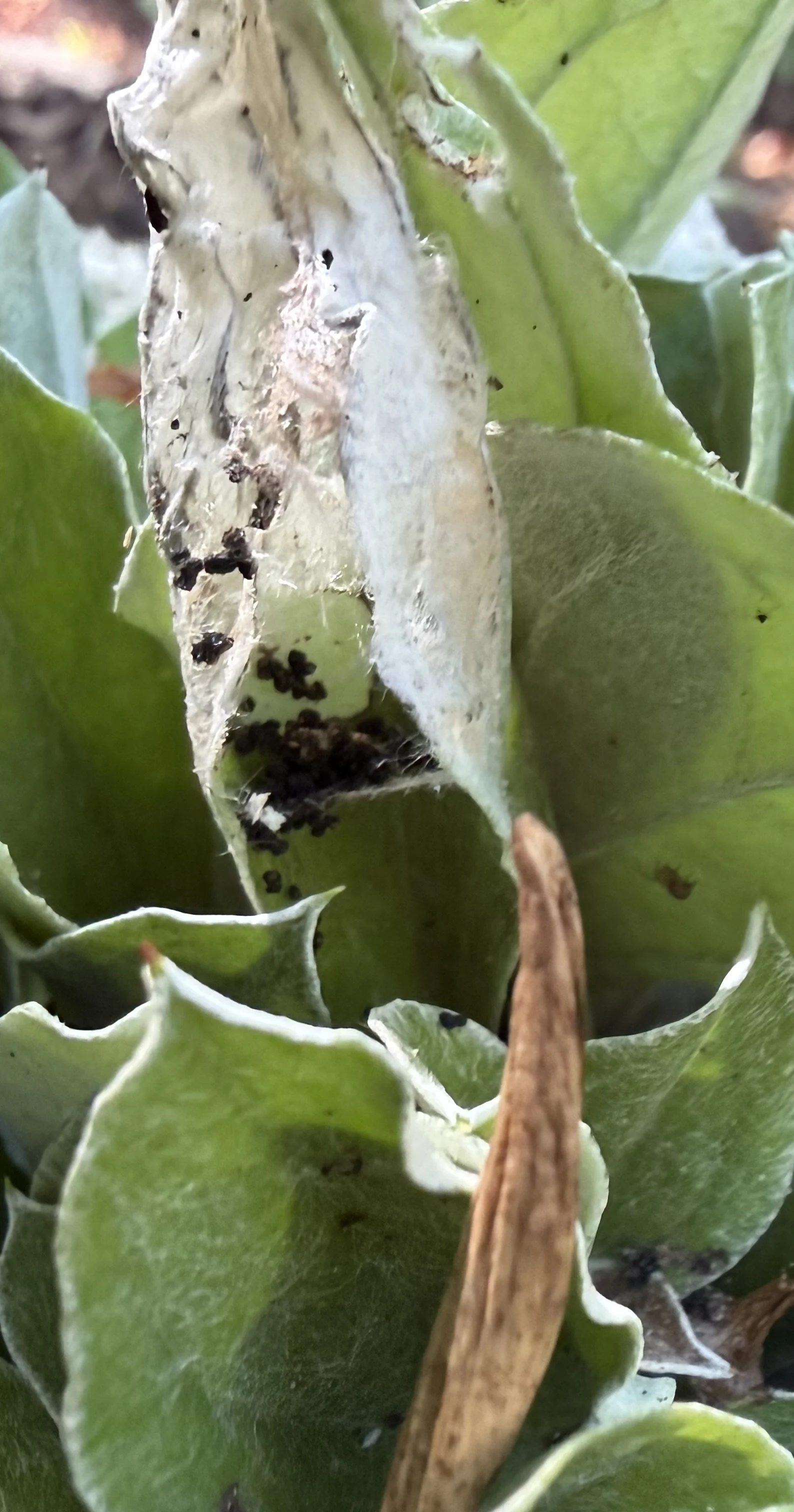
And instead of feeling alarmed, I felt excited.
I did spend some time trying to figure out what had been there. I never reached a confident identification, but I realized that was not the most important part. Something had found my pussytoes and used them.
The plant was being used.
That experience added a piece I had been missing. I already knew that supporting pollinators meant more than planting flowers. Habitat can include places to shelter and nest, fallen leaves, standing stems, and plants that support insects during different stages of their lives.
What I had not really considered was that some of the signs I saw as damage could also be signs that the habitat was working.
For butterflies and moths, for example, flowers are only part of the picture. Their caterpillars need suitable plants to feed on. A leaf with a few holes may not look perfect, but those holes can be a sign that the plant is supporting insect life.
Of course, this does not mean every damaged leaf should be celebrated or ignored.
Some insects can seriously harm a plant. If damage is severe, spreading quickly, or you suspect an invasive species, it makes sense to look more closely and decide whether to act. And I am completely willing to admit that I feel differently about something eating the tomatoes I plan to eat than I do about a few holes in a native plant I chose partly to support wildlife.
The point is not to stop caring for our plants. It is to pause before assuming that every sign of feeding needs to be fixed.
Before you treat, take a beat.
Look at the whole plant. Is it otherwise healthy? Is the damage limited to a few leaves, or is it rapidly getting worse? Look beneath the leaves and around the stems. You may find a caterpillar, eggs, frass, webbing, or nothing you can confidently identify at all.
You do not need to become an insect expert before deciding to wait and watch. Often, a closer look will simply reveal that a healthy plant has lost part of a leaf and is continuing to grow.
That was what surprised me about my pussytoes. What first looked like something to worry about became something that genuinely excited me.
My garden was providing more than flowers. It was being used.
So the next time I see a ragged leaf, some curled foliage, or a bit of webbing, I am going to try not to jump immediately to “What’s wrong?”
Maybe the goal isn’t a garden where every leaf looks perfect. Maybe the goal is a garden that is being used.
