
I Planted Milkweed From Seed. Then the Monarchs Found It
Last year, I started milkweed from seed.
I didn’t have a grand plan for where it was going to go. The little plants were still sitting in pots, I knew I needed to get them into the ground before they died, and there was a space where we needed something—and where not much else seemed particularly happy.
So I planted the milkweed there and thought, Let’s see what happens.
That first year, the plants were pretty small, each just a single stalk. But somehow, monarchs found them. I spotted two caterpillars that summer.
I never found their chrysalises and never knew what happened to them, but just seeing monarch caterpillars on milkweed I had grown from seed felt like a small victory.
Then the milkweed came back this year.
And it really came back.
Each plant now had four or five stalks. Then one Saturday evening, I happened to look at the milkweed and saw a monarch caterpillar.
I looked a little more closely and found another.
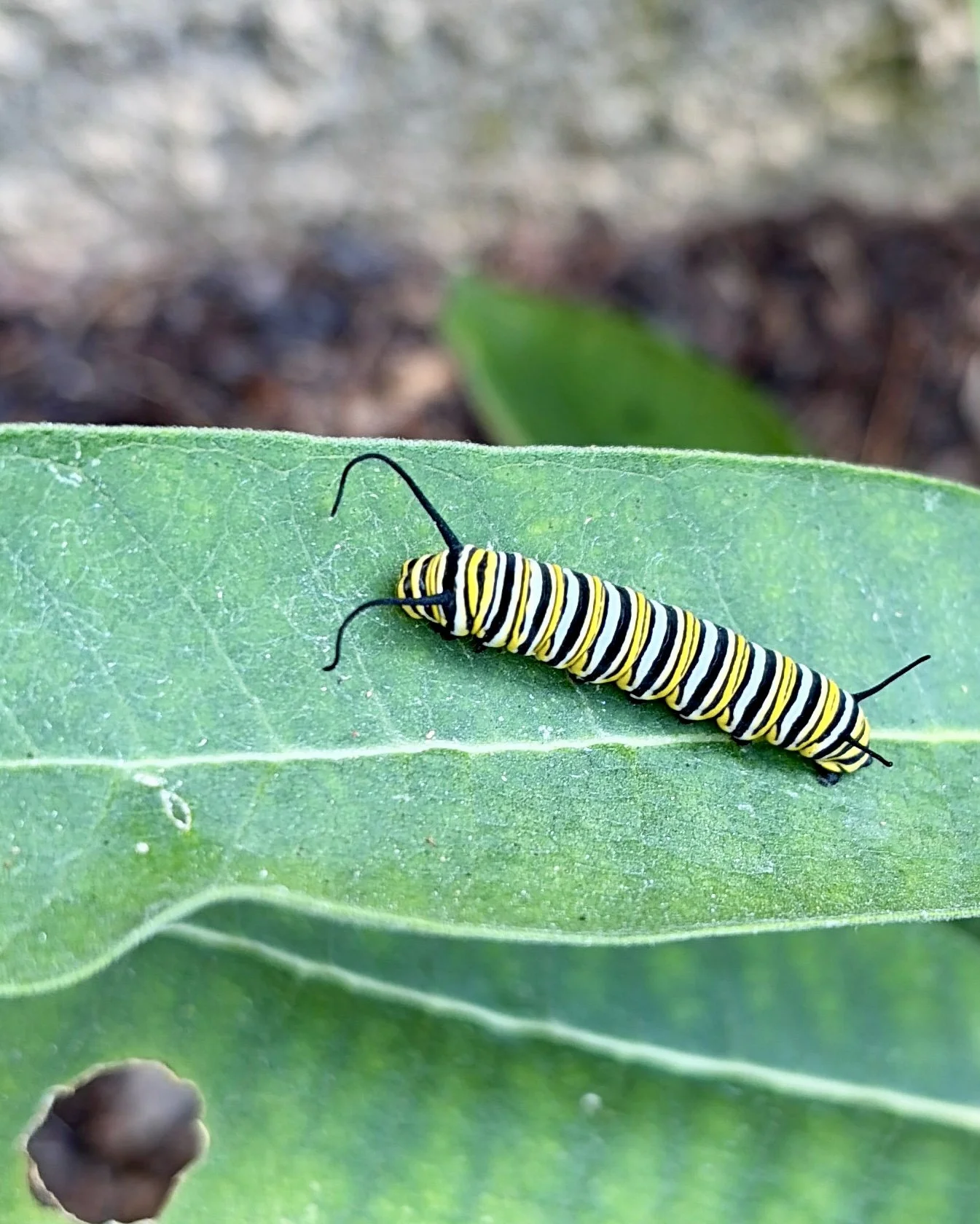
And then it became:
Oh my gosh, there are three.
Wait—FOUR.
Oh man. FIVE!
My partner, Mark, was outside, so of course I immediately told him.
And then, equally of course, I got my phone.
And then I became slightly obsessed
From that point on, I checked on them constantly.
Were all five still there?
Where was number four?
Was that the same one I saw before, or a different one?
I’d found them Saturday evening and kept checking through the weekend. But by Sunday night or Monday morning, I couldn’t find all five anymore.
When I wasn’t at Mark’s, he became the caterpillar correspondent. By Tuesday, he could only see two or three.
I was worried.
What I didn’t know then was that disappearing can be part of the story.
When monarch caterpillars reach their final stage before becoming a chrysalis, they commonly leave the milkweed they’ve been eating and go looking for somewhere protected to pupate. They can travel surprisingly far—sometimes around 30 feet—and they don’t necessarily choose another plant. They may attach themselves to trees, other vegetation, structures and, yes, even the side of a house.
Which brings me to Friday.
“Are you sitting down?”
Mark sent me a text:
Are you sitting down?
He says that often enough that I assumed this was going to be something about our seemingly endless house project.
It wasn’t.
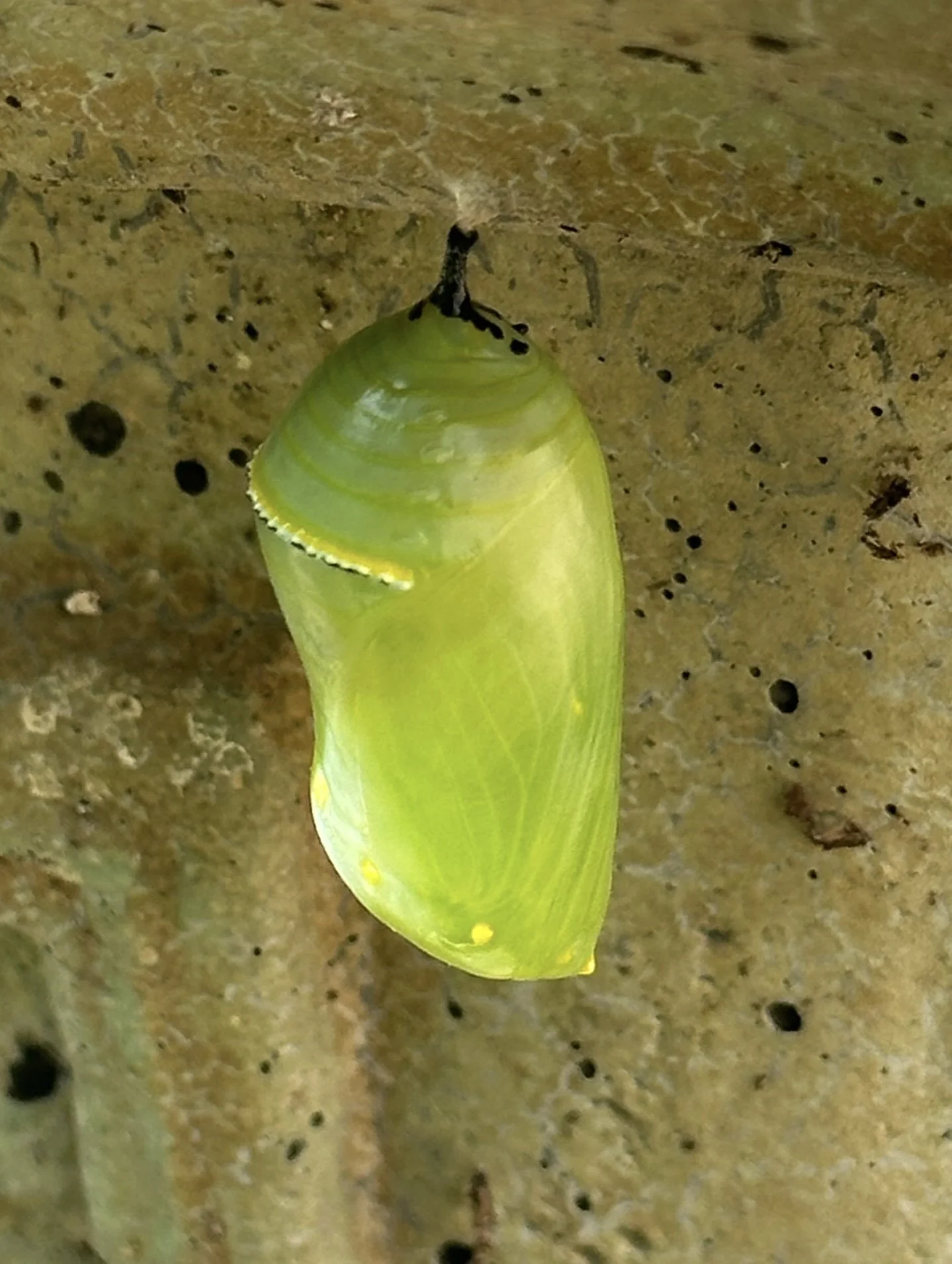
He sent me a picture of a chrysalis.
I had no idea how beautiful a monarch chrysalis was.
It looked like jewelry.
Bright green, smooth and almost impossibly perfect, with tiny metallic-looking gold details.
And now that I knew what I was looking for, I couldn’t wait to get there and start searching for the others.
We found three more.
One was tucked way up underneath the eave of the house—easy to miss if you didn’t know what you were looking for.
Two had chosen places I never would have expected: one was attached to a glass window and another to the metal around a window.
Suddenly the missing caterpillars weren’t quite so mysterious.
They hadn’t necessarily disappeared.
They had moved.
And then there was number five
There was still one caterpillar left.
Number five.
I watched that one constantly.
Then on Saturday, I couldn’t find it anywhere. Not on the milkweed. Not hanging nearby. No new chrysalis.
Eventually, Mark found it on the underside of the rim of a planter, just above where he’d discovered the first chrysalis.
I was convinced.
That’s where it’s going to do it.
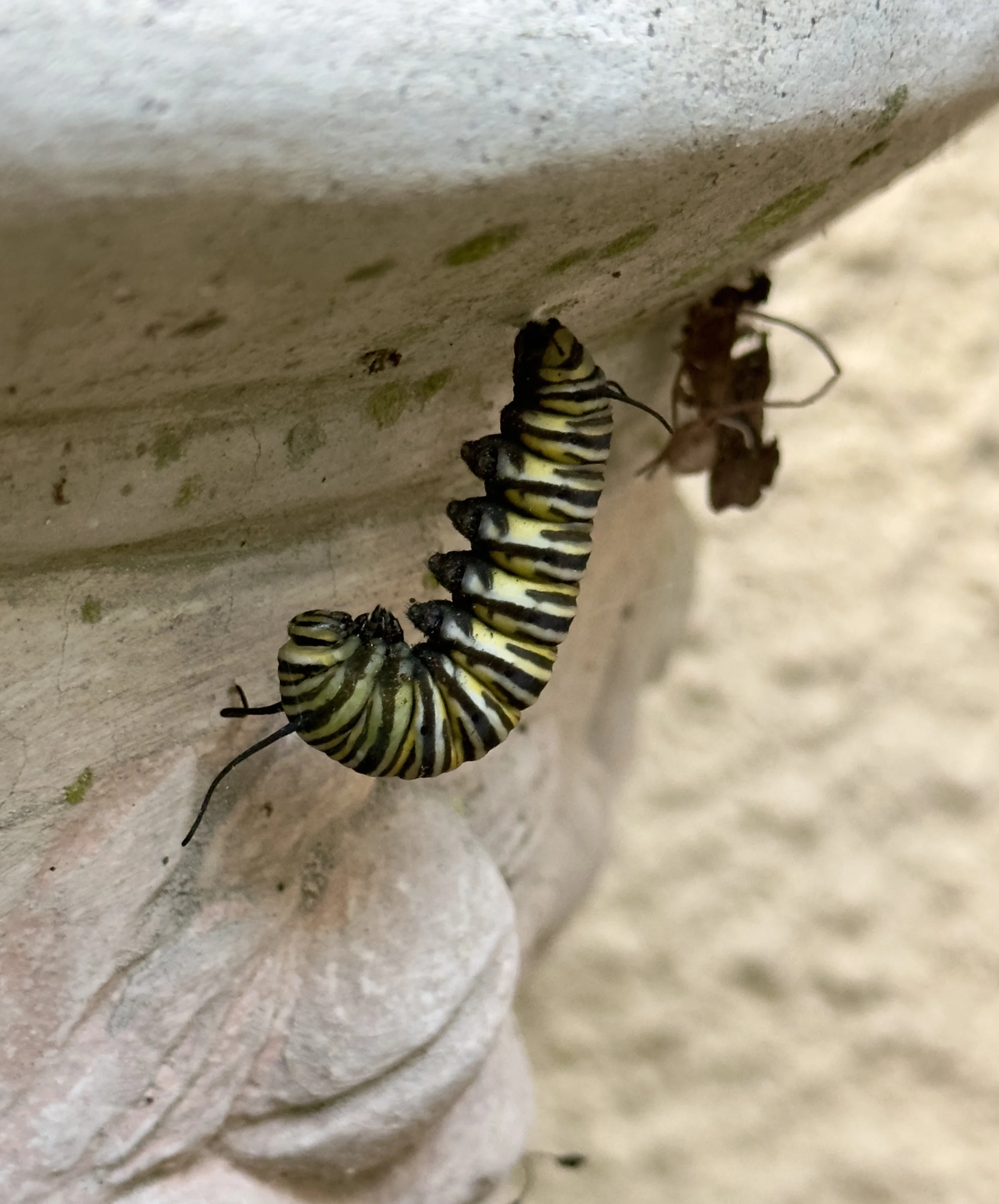
When a monarch caterpillar is ready to pupate, it creates a small silk pad, attaches itself and hangs upside down in a distinctive J shape. Then it molts one final time, becoming the green chrysalis.
So now we had something new to watch.
We checked throughout the day.
We went to dinner.
When we came home, still no J.
When we went to bed, still no J.
The next morning?
There it was.
Hanging upside down in a perfect little J.
We were going hiking that day, so before we left, we made predictions.
Mark thought we’d come home to a complete chrysalis.
I guessed we’d catch it somewhere halfway through the transformation.
We were both wrong.
When we got home, it was still hanging there.
When we went to bed, still no chrysalis.
But the next morning...
There it was.
The fifth green chrysalis.
Five caterpillars.
Five chrysalises.
What might come next
Once all five were in their chrysalises, I started reading about what came next.
A monarch typically spends roughly 8 to 15 days in the chrysalis under normal summer conditions. But what caught my attention even more was when these butterflies would be emerging.
Most monarchs born during the spring and summer live as adults for only a few weeks. They mate, lay eggs and produce another generation.
The northward journey of monarchs begins in spring and continues over several successive generations. No single butterfly makes the entire trip north.
Fall is different.
Monarchs emerging during the fall migration period can enter what’s called reproductive diapause. Instead of immediately putting their energy into mating and laying eggs, reproduction is delayed.
Those monarchs can live for many months.
They need that extra time because eastern monarchs participating in the fall migration may travel thousands of miles, with some traveling as far as 3,000 miles from Canada and the northern United States to the mountain forests of central Mexico.
Then I learned something else I couldn’t stop thinking about.
They’ve never made that trip before.
The journey north required multiple generations.
Then, in the fall, a new generation heads south.
No parent shows them the way.
Whether each of my five will become part of that migration, or how far any one of them will travel, is something I can’t know.
But they were emerging here in Massachusetts in September, right as the fall migration was underway.
I was already a little excited about those five green chrysalises hanging around the house. Learning that they were emerging at the time of year when the monarch “super generation” begins its journey south made me look at them a little differently.
And then they started emerging
Naturally, once I knew approximately when they might emerge, I started researching what I was supposed to look for.
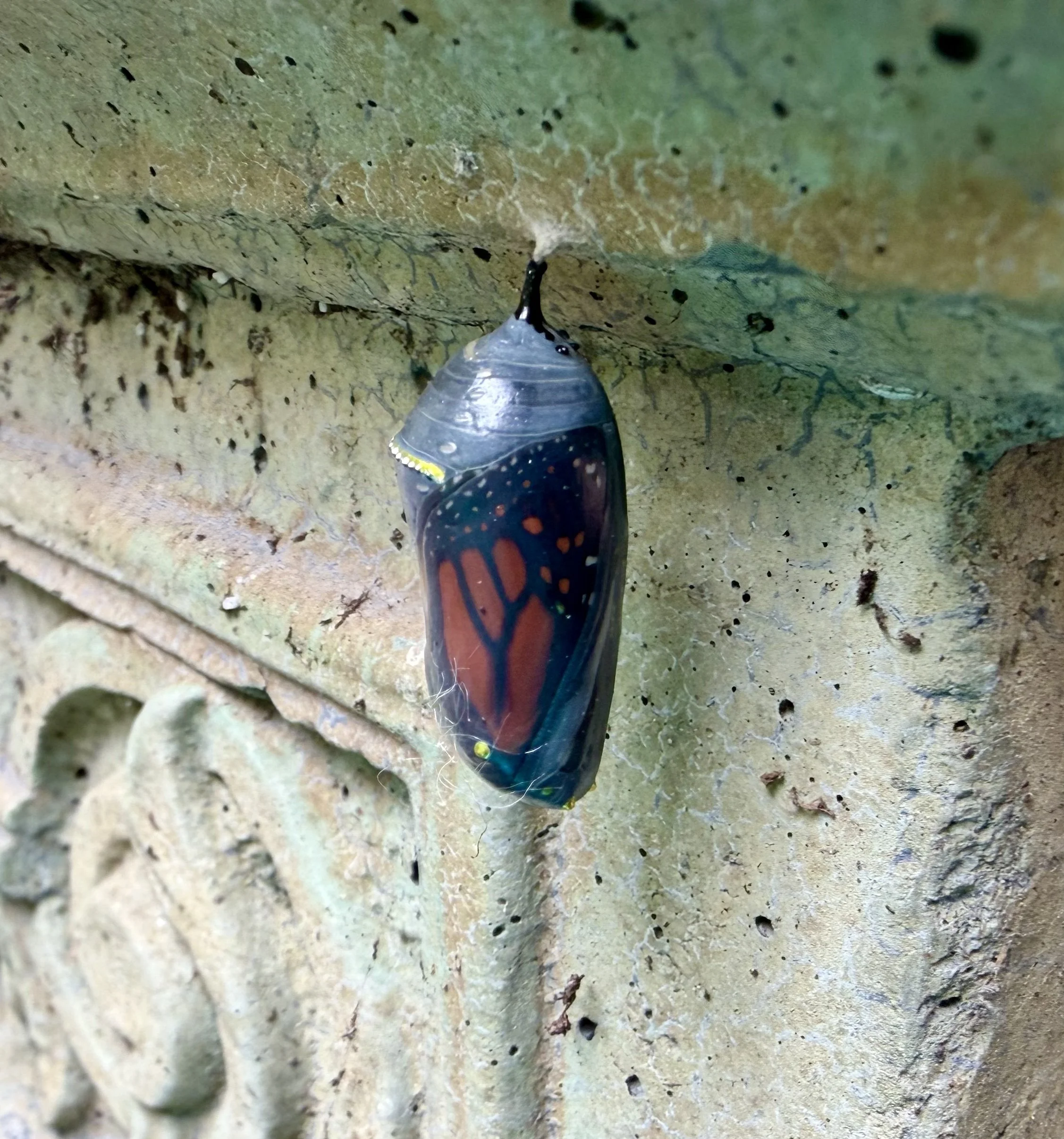
One sign is that the chrysalis darkens and the orange-and-black wings become visible through it.
I knew that was what we were waiting for.
The first two beat us to it.
On Thursday, Mark found two empty chrysalises.
That was it. They had emerged, and neither of us had seen it happen.
Then on Friday, the third one gave us more warning.
Mark sent me a picture of the chrysalis. The bright green was gone, and you could clearly see the orange-and-black wings inside.
Then came the next stage.
The butterfly was out, but its wings were still hanging down and didn’t yet look like the familiar monarch wings you picture flying through the garden.
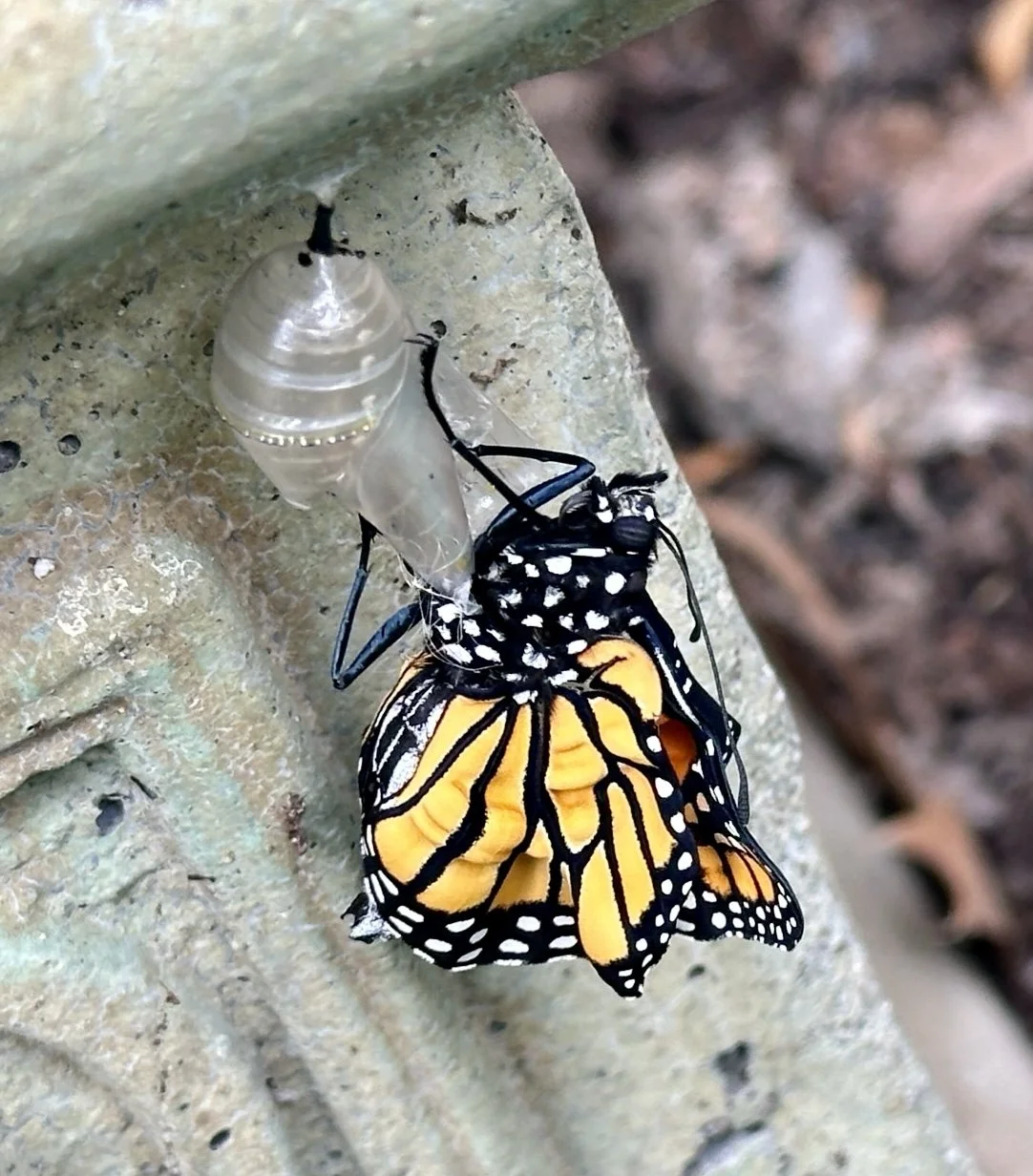
Later, another photo.
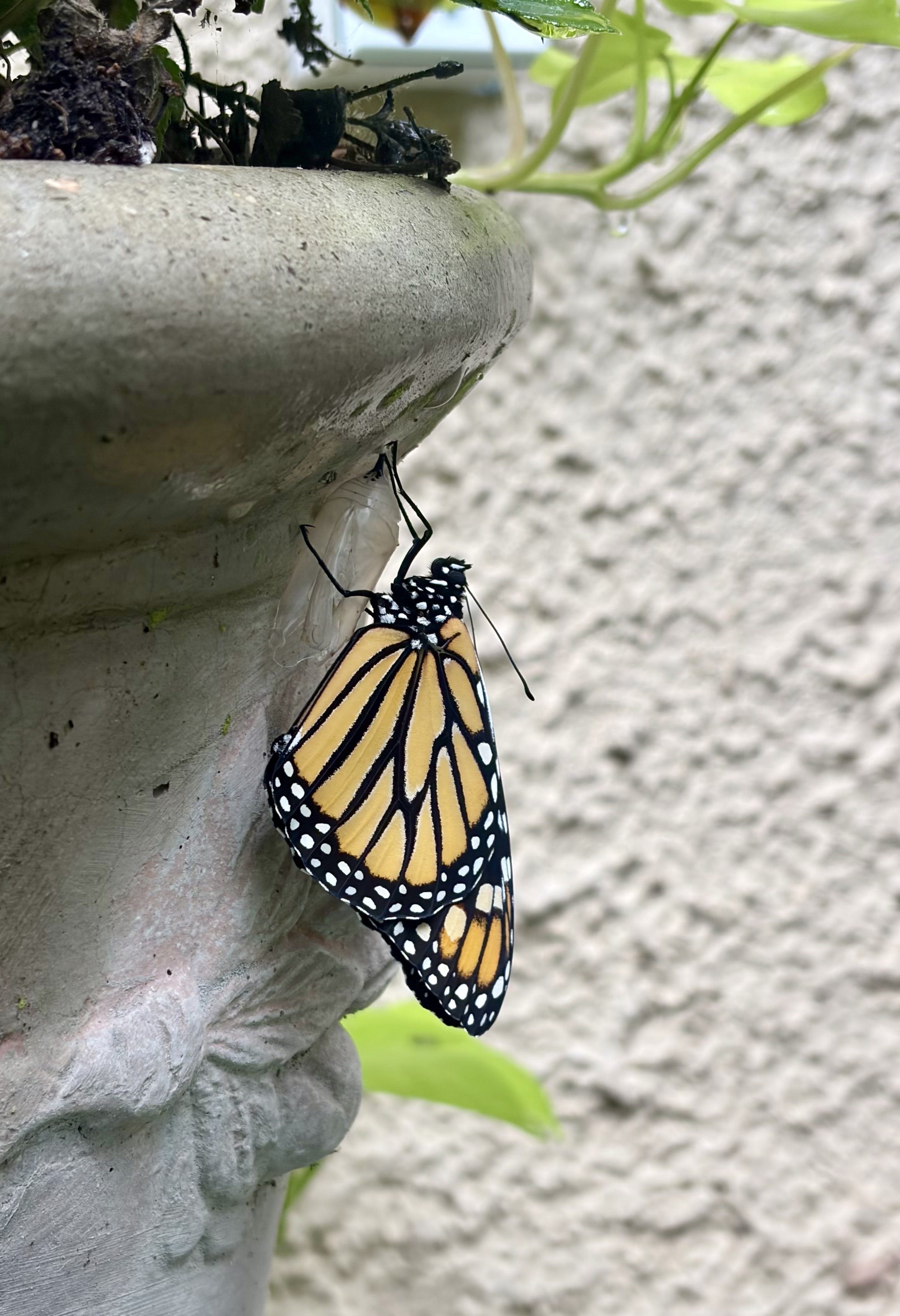
This time, there it was.
A monarch butterfly.
Fully out, wings expanded, sitting where the chrysalis had been.
Mark saw it there for a while. When he came back later, it was gone.
The fourth emerged after that.
And today, the fifth—the last of those original five caterpillars—emerged too.
Five caterpillars.
Five chrysalises.
Five butterflies.
The part I keep coming back to
Last year, these were just a few small milkweed seedlings sitting in pots.
I wasn’t sure exactly where to put them.
I wasn’t creating the perfect monarch habitat. I wasn’t following some carefully designed garden plan.
I just knew I needed to get the plants into the ground, and there was a spot where not much else was thriving.
So I planted them.
Last summer, two caterpillars found them.
This year, the milkweed returned bigger.
And five monarch caterpillars found it.
Those caterpillars disappeared from the plants, turned up in places around the house I never would have thought to look, became five chrysalises—and now, five butterflies.
There’s no guarantee when we plant something that we’ll ever get to see what it makes possible. Nature doesn’t work on our schedule, and it doesn’t always give us immediate feedback.
But every once in a while, we get lucky enough to see it.
And this time, I got to see quite a lot.
